Announcement

Collapse
No announcement yet.

The 3d Monopole Coil How To Build

Collapse
X
 
  • Filter
  • Time
  • Show
Clear All
new posts


  • Hi John,
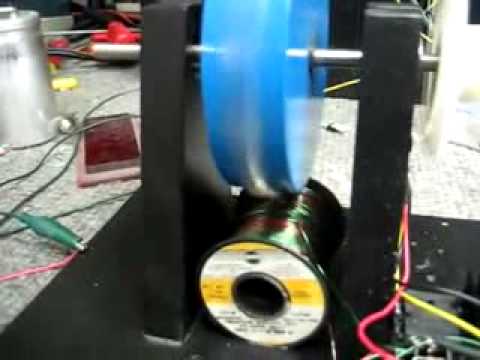
    thought I would have a go at replication on the Zero Force. This is just "take one". I should wind some actual balanced coils for this.
    Is there a rule of thumb you use to balance Awg/Ohms vs magnet strength and voltage?
    Or what are you using so I can try to match...
    Thanks - Kind Regards - Patrick A.

    Comment


    • Originally posted by min2oly View Post

      Hi John,
      thought I would have a go at replication on the Zero Force. This is just "take one". I should wind some actual balanced coils for this.
      Is there a rule of thumb you use to balance Awg/Ohms vs magnet strength and voltage?
      Or what are you using so I can try to match...
      Thanks - Kind Regards - Patrick A.
      John,

      Many, many thanks, never heard of that one from you. Patrick, thank you for the video. John/Patrick you know I don't build as much as I should and come at this from a very naive perspective, still I will go ahead and ask and "possibly" someone has already looked at this, but what about the obverse? I.e. you are saying there is a "zero-force" machine that undergoes motive force, what about a pick-up coil? Is that a zero-force generator?

      Comment


      • So I had a moment and thanks to a PM, I realized I was "scoping" in a room that my scope picks up quite a bit of the home mains. That is you should notice in my last vid there is a 60ish hertz sine wave where there should be no wave. I moved the project to a different room.
        I'm also running in the the Bedini/Cole switch

        I just uploaded so it might take a bit before youtube processes...
        KR - Patrick A.
        Last edited by min2oly; 11-02-2015, 09:41 AM.

        Comment


        • nice work Patrick!

          Comment


          • Thanks John.

            Here's a quick look at the toroidal design I'm working on.

            This is the 3rd toroid I wound up. tried 40awg wire on the first one and had to take it up to 24 volts to get it to spin!

            Comment


            • now that they have Magnetic Iron PLA for 3d printers it would be interesting to see a iron printed toroid.... throw a generator coil on there pat and do some tests for us!!

              Comment


              • Click image for larger version

Name:	bedini-1.JPG
Views:	1
Size:	108.4 KB
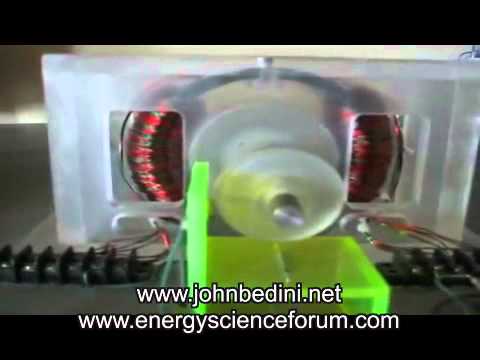
ID:	47158 - dont forget this picture of a generator from johns old book i believe

                Comment


                • On this slide, we show a theoretical scheme which several researchers have discovered and used to build simple free energy motors.
                  In this scheme, we drive an ordinary d.c. series motor by a two wire system from an ordinary battery. The motor produces shaft horsepower, at -- say -- some 30 or 40 percent efficiency, compared to the power drained from the battery. This much of the circuit is perfectly ordinary.
                  The trick here is to get the battery to recharge itself, without furnishing normal power to it, or expending work from the external circuit in the process ( The Monopole).
                  To do this, recall that a charged particle in a "hooking" del-phi river moves itself. This is true for an ion, as well as for an electron. We need only make the del-phi in correct fashion and synchronize it; specifically, we must not release the hose nozzles we utilize to produce our del-phi river or waves. The inventors who have discovered this have used various variations, but here we show a common one. First, we add an "energizer" (often referred to by various other names) to the circuit. This device makes the del-phi waves we will utilize, but does NOT make currents of electron masses ( The MonopoleSwitching Circuit Monopole). During one pulse, the battery is connected and furnishes power to the motor; during the succeeding pulse, the battery is disconnected completely from the motor and the output from the energizer is applied across the terminals of the battery (Secondary Battery).
                  If frequency content, spin-hole content, etc. are properly constructed by the energizer, then the ion movements in the battery reverse themselves, recharging the battery. Again, remember that these ions MOVE THEMSELVES during this recharge phase. Specifically, we are NOT furnishing ordinary current to the battery, and we are not doing work on it from the energizer. "The Monopole does all of this"

                  Last edited by John_Bedini; 11-09-2015, 11:22 PM. Reason: information
                  John Bedini
                  My homepage: http://johnbedini.net

                  Comment


                  • Those two have put themselves in a box - they see and hear things only as they understand them. I heard what you said in the video clearly, you even pose the question what is this (ZeroForce) running on? This version is running on the super north. I'm the patrick on the other forum who tried to point them in the right direction, it's my comments that "Lidmotor" has now muted for trying to help. Egos run big on the youtube with some. After the exchange with them I decided not to share that I have mine making the double pulse like you do. I could not do it by turning the reed sideways so I added the two magnets on the timing wheel like Peter did. I'm still monkeying around with the spacing and timing, I might move to the hall switch.

                    Anyway, wow! This is a juicy post. My common sense, friends on this forum, and actually listening to you are the only things I can point to that have got me as far as I have with the monopole. I've always tinkered looking for exactly what You and Tom B. describe here. I just don't have enough knowledge to make the jump however. I look forward to this path you are on with eyes, ears and mind wide open. Thank you John for keep'n on!
                    Kind Regards - Patrick


                    Originally posted by John_Bedini View Post
                    ---------------- snip------------- i had to snip this as the forum error told me the post was too long (Patrick - Min2oly)

                    Comment


                    • Nice build Patrick, I always love your videos you are so creative with materials.

                      Tom C


                      experimental Kits, chargers and solar trackers

                      Comment


                      • Click image for larger version

Name:	monopole for d.jpg
Views:	1
Size:	115.2 KB
ID:	47162
                        John Bedini
                        My homepage: http://johnbedini.net

                        Comment


                        • Hi John,

                          Originally posted by John_Bedini View Post
                          At All,
                          ............This machine does not require a transistor to run and would make a hell of a lot more power done with brushed contacts, and timed right. The coil may not operate like you think as it really is an energy pump if used correctly. The monopole is the first machine condensed into one unit
                          [ATTACH=CONFIG]4846[/ATTACH]
                          I'm a little confused with some of your explanations.
                          And, in an earlier post, you stated
                          The machine will be a Monopole the arrangement will be different and easy to build, so just a self-rotating energizer.
                          Are you describing an SSG machine with brushes and commutator in place of the trigger winding, transistors, and diodes? That's how I envisioned what you are saying.

                          Also in the previous post you said.....
                          ... I can see that I must post the real machine again in a video so you can see what kind of power it has as it will burn your fingers off so maybe we should rename it to the Zero Force turbine. And no it never used any Iron in anything....Another thing is this machine is based on diamagnetic materials and Quantum Mechanics and what the fields do. .... I only find one person here that caught on to what it was and that person is Brodie Gwilliam you have got it so see the machine is in the first book, good research Brodie.
                          Are you here describing the zero force "turbine" driving the alternator shown in figure 10 of your book?

                          Comment


                          • Comment


                            • Hi John

                              Thank you for heading in this direction. Things are starting to make sense to me about this design. Let me see if I can get close to an explanation, in regard to what I perceive is happening, that is satisfactory. First, regarding the picture that Brodie posted--from an "old book" you put out--presumably the FEG manual others others talk about, which I do not have (I have all three SSG manuals). The motor appears to have two inductors with parallel capacitors, that are arranged in series. My recent research into LC circuits lead me to believe that the inductors with their parallel capacitors are, or could be tuned to a specific frequency(?) that would then be the natural resonant frequency that the motor would run at. Am I correct on that assumption? Then by placing the coils in series, as opposed to the single coil in your demonstration (more like the one that Peter built and you demonstrated in a video found on Aaron's Youtube site), one could gain useful shaft energy (as well as possible energy from low drag coils placed around the rotor), while running the motor with relatively minuscule amperage--and maybe feeding some of the energy rectified out of the circuit back to the drive battery like the "Window Motor" demonstration you did using the Bedini-Cole switch to regulate it. Am I picking up on what you are trying to say here? If this is true, one could run a lot of LEDs from this arrangement, and for a very long time (when there is no other power available, so-to-speak). Am I right?

                              James, somewhere in Idaho
                              Last edited by James_Somewhere_In_Idaho; 11-11-2015, 12:34 PM.
                              Best Regards ~ James, Somewhere In Idaho

                              Comment


                              • Originally posted by jamesgray3rd View Post
                                Then by placing the coils in series, as opposed to the single coil in your demonstration (more like the one that Peter built and you demonstrated in a video found on Aaron's Youtube site), one could gain useful shaft energy (as well as possible energy from low drag coils placed around the rotor), while running the motor with relatively minuscule amperage--and maybe feeding some of the energy rectified out of the circuit back to the drive battery like the "Window Motor" demonstration you did using the Bedini-Cole switch to regulate it.
                                Aaron Murakami

                                You never change things by fighting the existing reality. To change something, build a new model that makes the existing model obsolete.

                                Comment

                                Working...
                                X