Announcement

Collapse
No announcement yet.

Trigger Circuit Excessive Output

Collapse
X
 
  • Filter
  • Time
  • Show
Clear All
new posts

  • Prinsloo
    replied
    Originally posted by John_Koorn View Post
    Hi Theunis,

    In hindsight I should've wound a thinner trigger winding with all the power windings. Although I would still have to sacrifice a power winding because it's not physically possible to fit more than 130' of 8 x #18 on the spool that fits the coil holders that came with the 10 coiler kit.

    Not sure which other thread you are talking about as I had to clean out my PM inbox.

    John K.
    JohnK

    See http://www.energyscienceforum.com/be....html#post5136 ,post 169

    Can we ask LesK to share more of this info in this/a thread ? (seems like he is still waiting your answer !)

    (" . . . current causing both longitudinal and transverse waves to come out of the system simultaneously" )

    Is there another thread where advance builds with advance information are discussed/shared?

    Theunis
    Last edited by Prinsloo; 01-26-2013, 03:56 AM. Reason: typo

    Leave a comment:


  • Georgey Nico
    replied
    Hi John K

    If The spool were to have 4 or 5 strains it would be 150'' # 18 yes?
    Have you done any testing with 4 strains #18 @ 150 and the 5th of (23# trigger)is there any noticeable difference using an 18 #trigger.

    Cheers George N.

    Leave a comment:


  • John_Koorn
    replied
    Originally posted by Prinsloo View Post
    JohnK

    You lose the two strands that could have worked as power strands to the trigger, wouldn't it be better to then first wind the trigger on to the coil/core as long as you need it to be and then ad the power strands (litz wires). This way you still have the 8 power strands on the master coil to do some work.

    You will then also have the added advantage that LesK talked about in the other thread ! (remember he PM'ed you)

    Theunis
    Hi Theunis,

    In hindsight I should've wound a thinner trigger winding with all the power windings. Although I would still have to sacrifice a power winding because it's not physically possible to fit more than 130' of 8 x #18 on the spool that fits the coil holders that came with the 10 coiler kit.

    Not sure which other thread you are talking about as I had to clean out my PM inbox.

    John K.

    Leave a comment:


  • Prinsloo
    replied
    JohnK

    You lose the two strands that could have worked as power strands to the trigger, wouldn't it be better to then first wind the trigger on to the coil/core as long as you need it to be and then ad the power strands (litz wires). This way you still have the 8 power strands on the master coil to do some work.

    You will then also have the added advantage that LesK talked about in the other thread ! (remember he PM'ed you)

    Theunis

    Leave a comment:


  • John_Koorn
    replied
    Originally posted by Prinsloo View Post
    Thanks JohnK

    I am with you now, by doing this you did get a higher voltage on the trigger to drive all the transistors !

    thanks

    Theunis
    Hi Theunis,

    Yes, I could not tune the machine properly with just the single strand trigger winding.

    John K.

    Leave a comment:


  • Prinsloo
    replied
    Thanks JohnK

    I am with you now, by doing this you did get a higher voltage on the trigger to drive all the transistors !

    thanks

    Theunis

    Leave a comment:


  • John_Koorn
    replied
    Originally posted by Prinsloo View Post
    Hi JohnK

    Once again thank you for your time

    Please explain "so I have two windings in series for the trigger on the master coil." - your quote.


    Please explain in laymen terms, or lets say " Bedini for Dummy's "

    did you litz the trigger with the other wires?

    if so how did you get two wires in series?

    if it is two wires are they double the length (series) of the other wires?

    How?

    Thanks

    Theunis
    Hi Theunis,

    The coil was made with 8 strands of #18 wire, all wound together and twisted at 3 twists/inch.
    2 of the strands were separated from the other 6. The end of one of the two strands was connected to the start of the other of the two strands. This effectively made one single strand which is twice the length of the other 6 strands.

    Hope this makes sense...

    John K.

    Leave a comment:


  • Prinsloo
    replied
    Hi JohnK

    Once again thank you for your time

    Please explain "so I have two windings in series for the trigger on the master coil." - your quote.


    Please explain in laymen terms, or lets say " Bedini for Dummy's "

    did you litz the trigger with the other wires?

    if so how did you get two wires in series?

    if it is two wires are they double the length (series) of the other wires?

    How?

    Thanks

    Theunis

    Leave a comment:


  • John_Koorn
    replied
    Originally posted by Prinsloo View Post
    Hi John K

    Can you please give us the wire gauge size in the trigger winding on your 10 coiler mentioned above ?

    If I understand you correctly you have 1 trigger wire that is doubled the length of the power winding, it is wound on first and then the power wires over the trigger wire ?

    Thanks

    Theunis
    Hi Theunis,

    My trigger winding is #18 as well, wound on with the power windings.

    John K.

    Leave a comment:


  • Prinsloo
    replied
    wire gauge size in the trigger winding

    Originally posted by John_Koorn View Post
    Hey Bud,

    what size trigger wire are you using and can you measure the resistance of one of the windings? How many ohms are your individual base resistors? Can you post some scope shots?

    To give you an idea, my 10 coiler is all 8 windings of 130' of #18. Each winding measures 1.0 ohms, so I have two windings in series for the trigger on the master coil. My base resistors are all 100 ohms and the master base resistor is a 300 ohm 100 watt wire wound rheostat with a 12 volt car taillight in parallel. The rheostat is set at about 150 ohms and is not the slightest bit hot. The tail light is about half brilliance and gets a little warm as you'd expect. I am running at 12 volts primary and charge batteries and see no need to run at higher voltages.

    John K.
    Hi John K

    Can you please give us the wire gauge size in the trigger winding on your 10 coiler mentioned above ?

    If I understand you correctly you have 1 trigger wire that is doubled the length of the power winding, it is wound on first and then the power wires over the trigger wire ?

    Thanks

    Theunis

    Leave a comment:


  • Forrest
    replied
    Hi Patrick,

    I am definatly on it. Just gotta make the time.

    Bud

    Leave a comment:


  • min2oly
    replied
    Originally posted by John_Koorn View Post
    Hi Bud,

    The lack of base resistors makes sense as to why your rheostat is getting warm. If it was my setup I would put 100 ohm base resistors on each of the trannys, series up two of the windings for the trigger (or re-wind the coil with a #23 trigger winding) and place the bulb in parallel with the rheostat.

    You should be able to tune the machine to one pulse per magnet pass and then use the rheostat to fine tune it to the fastest RPM. You may need a higher ohms rheostat if you run out of tuning room. Once you have it tuned that way, adjust the coil/magnet gap to see if you can get faster RPM - after doing that fine tune the rheostat again. Put aside 3-4 hours for the whole process.

    I would also run the machine for a few cycles with 12v on the front and back until you're comfortable of where the machine wants to operate. As you are using 6v batteries make sure you use the shortest and thickest cables you can get to join the batteries together - I use 3/4" copper pipes for mine. Don't start paralleling more batteries until you get the machine running right and are getting good results - remember the machine will attempt to lower the impedance of the highest impedance cell so if you have one cell in the entire bank with a high impedance all of the energy will go into that cell.

    BTW, I forgot to mention my 10 coiler is using a super pole rotor. But the process is the same for tuning.

    John K.
    I don't know why I always assume people know more or less what they are doing... :-)

    Bud, listen to John. there are a couple more reasons you want those base resistors in there. Also, make sure you measure them (ohms), see that they all match.
    Did you match your transistors?
    Keep up the hard work Bud, you'll get there.
    Kind regards,
    Patrick

    Leave a comment:


  • Forrest
    replied
    Hi John,

    Thanks for the reply. After I thought about it for around 2 hours this morning in bed it finally sank in. You want to provide a high enough voltage spike from the two series trigger coils to be able to put the 100 ohm base resistors on the trannies and the have room for a common base resistor. This part is tough for me as I do not understand the engineering aspect of electronics but it does make sence. Will definately give it a try when I have a free moment. I have all the parts to make this happen but like anything else just making the time.

    Bud

    Leave a comment:


  • John_Koorn
    replied
    Hi Bud,

    The lack of base resistors makes sense as to why your rheostat is getting warm. If it was my setup I would put 100 ohm base resistors on each of the trannys, series up two of the windings for the trigger (or re-wind the coil with a #23 trigger winding) and place the bulb in parallel with the rheostat.

    You should be able to tune the machine to one pulse per magnet pass and then use the rheostat to fine tune it to the fastest RPM. You may need a higher ohms rheostat if you run out of tuning room. Once you have it tuned that way, adjust the coil/magnet gap to see if you can get faster RPM - after doing that fine tune the rheostat again. Put aside 3-4 hours for the whole process.

    I would also run the machine for a few cycles with 12v on the front and back until you're comfortable of where the machine wants to operate. As you are using 6v batteries make sure you use the shortest and thickest cables you can get to join the batteries together - I use 3/4" copper pipes for mine. Don't start paralleling more batteries until you get the machine running right and are getting good results - remember the machine will attempt to lower the impedance of the highest impedance cell so if you have one cell in the entire bank with a high impedance all of the energy will go into that cell.

    BTW, I forgot to mention my 10 coiler is using a super pole rotor. But the process is the same for tuning.

    John K.

    Leave a comment:


  • Forrest
    replied
    Hi John,

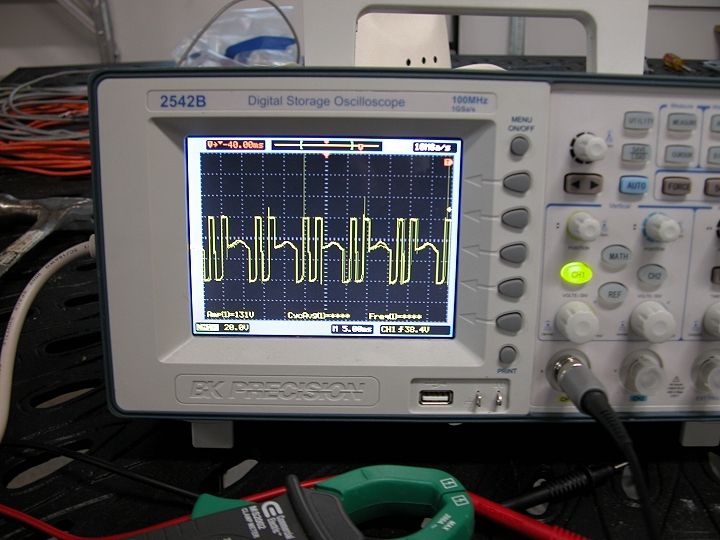
    The trigger wire is #19 - 130' long and the one winding #18 - 130' measures 1 ohm. I do not have any base resistors. Scope shot is as follows:


    Both of these coils have 8 windings #18 @ 1 ohm each + trigger. My light is in series with the rheostat. Might need to be parallel? I have changed the rheostat to 25 ohms and the temp is much lower. 98 degree. This is that screen shot @ 25 ohms. All transistors fire as this screen shot shows....I checked each one and they are all identical. If I add any more resistance the transistors fire more times per magnet pass. I do not know where that resistance is so I order a much larger rheostat to put in here later.

    In comparison my duplicate of Johns shop SG where the coils are 7leads plus trigger I find the resistances of the base resistors and base resistors very much like you stated above. For some unknown reason the extra lead makes the control resisitance of the trannies much lower. Do you have any idea why?

    I have been charging on this 24v bank for 7 days now. Started @24.8 volts and now @ 27.2.....this would be the long section of the charge cycle. So we will wait and see. This is why I chose 24-30 volts to see if I could actually charge the bank as a unit 700+ AH in a shorter time span.

    Looking to build a much larger unit but wanted to know the exact details of coil design and why before jumping into that big of a machine. Don't want to make it wrong. This is why all the prototyping first.

    Bud

    Leave a comment:

Working...
X