The gravity / aether / magnetic / electric subject is very interesting.
The gravity been the aether effect on a large object, like a planet, is very interesting and straightforward,
it might be as you guys say, that the planet distorts the aether around it and that is what we see as gravity.
or it might be as I saw on a video that I told about, that the aether enter the planet in all directions with lets say "10" of force, and the other aether that comes from the other side of the planet and has to get through it, it looses "power" or "speed" or whatever, and exits the earth with say "5" of force. So in all parts of the earth we get a aether with force "10" from the top, and "5" from below, and that is why we get a pulling down force on the surface of earth.
Anyhow, both theories implies that the aether is there, we can suck it, or alter it to get antigravity, etc. I have to get back to Peter L website where we talks about a person creating anti gravity with 2 parallel plates electrified in different ways.
best,
Alvaro
-
Hi Aaron,Originally posted by Aaron Murakami View Post
I'm in Absolute agreement with You..!! JB said (his website) that the motor was the ineffeicent part of the whole system in his 1984 endavour of a self-sustained motor/generator system..and then he came up with the SSG Energiser that we know today. it is simple..if you seek Torque go with the 1984 machine..if you seek Energy storage go with with 2000 SG... but yes his 10 coiler is a combo of both i still feel!!let alone the obscure Magnetic structure of the rotor. I do not understand Quatranion math but but i'm ahead from the opposite route to get it all right!! Maths by itself is a Science, people have ruined it altogether to make it complicated.
the picture you posted is monumental of its day i must say.. I can also say it is the E.V Gray machine scaled down in a way, Build that Energiser and configure it the right way and you have done it!! how many have replicated it here..???
I would love to exhibit my model in the up comming Conference if you let me
Rgds,
Faraday88.Last edited by Faraday88; 02-15-2017, 08:30 AM.Leave a comment:
-
That switch is based on a different application of this:Originally posted by Faraday88 View Post
Attached FilesLeave a comment:
-
-
Hi Aaron,Originally posted by Aaron Murakami View Post
By two ''Conversion'' methods i mean exactly like what Peter said either Inductive or Capacitive Fractionation. the Cap dump is the SPACE switicing(what you showed as A-B-C in your diagram) as per me...and the Inductive spike capture is the TIME Evoke method of Radiant electricity. i do not know how you can trigger the later(TIME evoke) other than what JB showed us (Transistor/Trigger method) iam refering to this Switching that is the basis of the SG spike production.
Yes, that is what is done in the pat# 6,545,444 the Cap dump and What you showed here is also what is applicable in the Pat #6,545,444 the Time evoke is done at two different instances as per me..with the Magnetic structure i showed the rotor runs at constant high RPM even when the back battery is as low as 7.45V (of a 12v Battery) with that said, the pat#6,545,444 is truely a combination of JB's 1984 Single battery(front) Machine and his 2000 SG (dual capture)implementation.. self runner.
Rgds,
Fardaay88.Last edited by Faraday88; 02-14-2017, 07:47 PM.Leave a comment:
-
Originally posted by Dwane Dibley View Post
I'll definitely look into that. Sounds very in alignment with JJ Thomson and Faraday.
This is copy and pasted from Eric Dollard's Power of Aether presentation page:
For many years, it was thought that there were magical interactions between things at a distance much like quantum physics of today.
Michael Faraday developed the ideas of the Lines of Force, which shows the interconnectivity between electrified and magnetized objects.
J.J. Thomson is the key person here who allowed us to express this in simple mathematical form.Thomson came up with the dynamics of these Lines of Force, which he called Tubes of Electric Induction and this became an engineerable manifestation of the aether even though the aether itself remains an unknown. His most important concept is that the aether is the storehouse of momentum. This means that when the aether is electrified, it exhibits the properties of a substance with inertia and momentum that acts upon physics matter. This leads to an understanding that matter in and of itself is an accretion of the aether.
The Aether Physics of J.J. ThomsonThomson came up with the dynamics of Faraday's Lines of Force, which he called Tubes of Electric Induction and this became an engineerable manifestation of the aether even though the aether itself remains an unknown.His most important concept is that the aether is the storehouse of momentum. This means that when the aether is electrified, it exhibits the properties of a substance with inertia and momentum that acts upon physical matter.This leads to an understanding that matter in and of itself is an accretion of the aether. Thomson shows that the aether is a substance that is directly engineerable both mathematically and in concrete form and that there is a direct equivelancy between aether and matter.J.J. Thomson's work has not been understood very well as there is no continuity between the variables used in his mathematical equations. One letter may represent something in one part of his writings and it may mean something entirely different in another. Part of this work has been to straighten out the confusion in his book Electricity and Matter so that others can begin to see what he was getting at. This has never been done until now!This is the practical foundation for not only understanding the physics of the aether, but in being able to apply practical engineering to it.Thomson is credited with the discovery of the electron, but it was his studies into the Aether physics and the Faraday Tubes, which led him to that discovery to begin with. Much of this history is covered up and discarded in conventional material and these notebooks delve into the facts.
Thomson also had the most quantitative theory of an electrified theory and this is what Dollard is expanding upon in these notebooks.
Leave a comment:
-
The switch I showed does not change how the SG is triggered. It is in series with the battery so that when the long contact is in contact, the battery is connected and it runs in normal mode. When the gap comes, the input battery disconnects and the small short contact gets switched on and at that point, the recovery cap gets dropped to the front battery.Originally posted by Faraday88 View PostLeave a comment:
-
Hi Aaron,Originally posted by Aaron Murakami View Post
If you read chapter 16 of Davson's book - Gravitation , it is easy to see that Schappeller had formulated a notion of stored "Inertia". As an object passes through the ether vertically up or down this storage either decreases or increases. If an object is travelling parallel to the lines of force, so to speak, inertia becomes more neutral.
Regards
DwaneLeave a comment:
-
Commutator switching is only for one type of ''Conversion'' the Bedini SSG energiser is a Magnetoelectrically triggered 'timing device''Originally posted by Aaron Murakami View Post
for the Dual counterpart of the ''Conversion'' this is accompalished using a Transistor only that JB introduced.
I personally do not know of any other mechanism that does this.
Rgds,
Faraday88.Leave a comment:
-
Feel free to post the YouTube link - video is horrible but shows the idea.Originally posted by Deuis View Post
Joseph Newman made serious use of commutators - complicated ones.
John's best self running results always seemed to be with mechanical switches.Leave a comment:
-
Hi Aaron,
Ive been building a mechanically commutated machine on another thread if you would like to put this video there that would be great.
Have you seen many commutators around? did anyone besides JB have a serious machine up and running?
Any tips or pointers would be great. I'm running a 24 segment commutator which gives me 12 degrees slots for coarse tuning and a rotating card for fine tuning.
Originally posted by Aaron Murakami View PostLeave a comment:
-
front feedback
Here is a video of the commutator - serious Hollywood production here That was about 10 years ago but I posted it a couple years back on that account I think.

My results weren't that great because you can see my ultra low budget build, but John's kept the front battery up for very long times - may have even climbed - I don't know what the long term results were, but that is how he sent recovery back to the front. I don't recall if that was in the 2nd SG or any books or not. He did that at the "Palace" building he was in and was before Peter moved to Spokane so that must have been around 2001.
I'm not getting comments on my space flux motor posts or the other stuff - not sure if anyone is interested in that kind of stuff but its a window into John's early on perspective going back to the 1970's.Leave a comment:
-
Hi Dave,Originally posted by Dave Wing View Post
I don't think you're coming at me - not in the slightest bit and I welcome all of it. There are however various clarifications that I think need to be addressed and defined because as you said, we need to be on the same page. I also don't have all the answers anyway as I stated in my first post and want to get the conversation going. I do have some for sure things I'll continue to share that wasn't left go guesswork when John shared them with me.
When you say the solid state SSG and ZFM produce a negative spike - now are you talking about during power on or power off?
For the power on spike effect, I searched to see if there was a transistor equivelant to switch bounce. With a manual switch, switch bounce will chop the power off and on and cause these spikes because if there is an inductor, that inductor is also discharging as it charges some and then discharges causing a spike(s) when turning it on. Many of those spikes can be less than 1 microsecond. There is something called Ground Bounce with transistors:
"In electronic engineering, ground bounce is a phenomenon associated with transistor switching where the gate voltage can appear to be less than the local ground potential, causing the unstable operation of a logic gate.
Ground bounce is usually seen on high density VLSI where insufficient precautions have been taken to supply a logic gate with a sufficiently low resistance connection (or sufficiently high capacitance) to ground. In this phenomenon, when the gate is turned on, enough current flows through the emitter-collector circuit that the silicon in the immediate vicinity of the emitter is pulled high, sometimes by several volts, thus raising the local ground, as perceived by the transistor, to a value significantly above true ground. Relative to this local ground, the BASE voltage can go negative, thus shutting off the transistor. As the excess local charge dissipates, the transistor turns back on, possibly causing a repeat of the phenomenon, sometimes up to a half-dozen bounces."
I don't know if that is what is happening but wanted to add that. The single transistor is not a microchip where it sounds like the ground bounce happens more often but it might be plausible that it causes the power on spike in any of these circuits. Coils that are rapidly charged can have power on spikes so that could be the source as well. Is the emf experiencing back pressure as it is applied to the coil and then the flow is established? If so, then that will raise its voltage higher than the source when the switch closes. In both cases, does anyone have an elegant solution to doing something with it? It would be taking it before it can be used so would that take away from what is needed for the applied charge?
John has mentioned the radiant that flows before current starts to flow when the power station operator closes the switch. That is a reference to early inspirations of Tesla's radiant matter electricity. But, radiant matter explosions are not created or used in John's machines. John has said for years the spike on the collapse is pure radiant potential, but anyone with a scope can see there is a small width to it meaning there is a little current associated with it. I think the primary point is that there is the emf (heaviside flow) that can exist without electron current, which is a component of Tesla's radiant matter process.
If we look at what the emf is made of, it is polarized and condensed positive "virtual photons" if you want to use Bearden's terminology that moves to the + terminal of the battery and flows over the wire towards ground. Being that there is 2 difference voltages - voltage potential - the pressure of that gas sitting a terminal of a dipole and then emf, the actual moving flow of that gas, which under normal circumstances is what potentializes and attracts the electrons from the copper atoms and attracts them towards the positive terminal. This is Bearden 101 so you I'm just preaching to the choir, but am posting for clarification.
So if that is what the EMF is, which can exist both with or without electron current, this gets compressed to a higher voltage potential when the coil turns off and that is how John is utilizing the same stuff that flows before current flows. He's sending it to a battery directly hitting with the a "potential charge" - the voltage push and the primary current develops in the battery on its own, which wasn't supplied by the circuit. John said there were 5-7 different currents flowing in a battery simultaneously so that gets complex. In any case, knowing what that stuff is that can flow before current flows lets us see how it is being used. The spike when the coil turns off is how it has been used and even if there is the spike when the power is turned on doesn't mean it is useful or is being used. The reference to the switch being closed causing it is to define that there is a flow that can move over the circuit before electron current moves.
@Bobzilla, I don't understand your circuit well and am have never used Adruino, but what you're mentioning to Patrick is the other way it is being used. It's still that potential charge to a battery where you don't supply current if you can slap that cap on the battery fast enough before current flows. Like I said I'm not familiar with what you were doing with it but sounds like you are rapidly blasting it multiple times to a battery in the same time that someone could dump it once - so you're taking multiple slices from it in the same time.
If we're just using a potential charge without current - if we have a cap charged to 50 volts and we hit the battery fast enough and if it only drops to 45 volts for example and not a full discharge, we hit the battery with 50 volts of pure potential. We only have to charge it 5 volts and not the whole fifty and can keep repeating so that we hit the battery with 50 volts of potential each time but we're only paying for 5 volts. Since we're not interested in actually getting the cap to charge with current, we don't need it discharged - just hitting the battery with polarized pressure. That's the idea anyway. This is basically the way this concept was always discussed at John's shop. However, I've never really seen this happen in its purest form. Look at these hundreds of amps peak current pulses from John's cap discharge circuits - electrical or mechanical - and you can see that the batteries are getting charged with serious impulse currents and not potential. Charging with spikes is a different story, but I haven't seen a cap make and break fast enough to prevent a significant current rush.
Maybe your computer controlled system can do it, I don't have experience with microcontrollers, etc. Actually I think Paul Babcock's switching circuits if tweaked for this application could be fast enough that there would be an extremely small amount of discharge to give a battery a real potential charge from a cap. If so, the caps can be topped up with flea power.
@Dave - you and everyone here probably already know this but this is the basic method that gave the best self running results I ever saw John achieve - or I should say that commutator method where caps were charged and then discharged to the front battery every 1/xth of the rotation - NOT this same circuit but with cap charger - large cap bank and mechanical switch:
Attached FilesLeave a comment:
-
-
Hi Dave,Originally posted by Dave Wing View Post
In my previous post i did mention it to Aaron that the N-face of the Magnet towards the coil core is the Natural Geometry for the Magnet's movement towards it and not at 90 degree, hence you flipp the Magnet at 90 degree (twice mutually) to fit for the direction for this Geometry.. does this not teach us what is it that we are doing ??? if you could make the magnet move inwards towards the coil inside i think that is all what we need!! but as i said it posses an Engineering challange but it can be done..! (btw this what is depcited in Stanley Meyer's EPG Magnetic circuit also!!), before we even get any further it has to be well borne in mind that the Bedini SSG/SG is an Accelerator machine which picks up speed with time (like a typical Particle Accelerator)and speed increase with time is the Energy gain! ofcourse the speed stabilizes at a point (since we have have scaled it to that level) the Radiant gain in the Battery is the Corresponding Electrical Equivalent of this ''Increase'' in the Speed of the machine.
The Natural Geometry posses another challenge in that the Increase in speed translates an orbital shift (imagine a Cyclotron) which makes the Magent confinement more difficult, hence John Bedini came up with this alternative arrangement to have the 'Rotor geometry constant, while have the Magneto-Interaction Dynamic by way of altered Magnetic Structure (Geometry)
Here it is again for all.
Rgds,
Faraday88.Leave a comment:
-
There is a lot being said here and it's hard to keep up but I wanted to at least try and answer you directly Patrick out of the great respect I have for all of the good work you have shared over the years. It would just be very rude not to try and answer you so here goes.Originally posted by min2oly View Post
The super fast switching is not necessary in my opinion to manifest either the pre or post current spike but you did pick up on me praising fast switching so I see how you might think I was saying that is conditional for one or the other to appear but the speed is just to use it to the highest advantage.
I actually don't want to get too hung up on pre and post spike because it's difficult to truly know for sure exactly whats going on anyway. Some may say it's a big spike at the end from the magnetic field collapsing, others might think it is a big spike just before the current starts to flow but we could all debate that for the next 10 years and still not all be in agreement. Again in my opinion which obviously anything I say is lol but we get both and they are so darn close together that we may as well just think in terms of both of them anyway. You not really going to get one without the other.
I would say that maybe take a second look at the 400v potential that that cap was manifesting on that old thread and ponder a bit on the whole situation there. I didn't make much of a big deal on that but it does speak to this very topic. I would also say that of the two kinds of spikes we are talking about here voltage or more properly said the potential increases radiant harvesting for both. In other words we all know from changing from 12 to 24v on any of our machines we see a lot more of the good stuff, or also increasing the potential between a cap and a battery, potential always plays it's part but it's cousin current does not need to. With the cap it was raised to a high potential and then fluttered off/on very fast so as not to allow much current to flow, as little as possible.To get instead of one pop to the battery with that potential of 45v, 50 pops instead. Current flows of course but you see the advantage if your only looking at the potential and how many make/break's I can buy with each cap fill up. At the time most people would charge up to say 30v and dunp that down in ONE shot to say 15v and then let the cap fill again and do it again,, well that was two dipoles where I would take 100 for the same potential. Hopefully your with me on that.
So lets think a moment on that 400v that showed up on the cap because of it. This was not the result of a heavy magnetic field collapsing now was it, it's not a coil after all. Sure there is some magnetism going on so don't jump me guys but it's not an electromagnet collapsing a heavily pumped up field. This is the pre current voltage. The other post current spike comes more from coils as I was trying to say. Usually you will not get much pre current spike, there will be some because there always is, but for the most part we are doing it the other way by pumping up a big old field in the coil and letting it snap back on itself.
I am finding it difficult to really explain this how I would like to but anyway just some thoughts from my perspective. Great conversation here guys it's good to see people active.Leave a comment:
-
Hi AaronIs it believed that John's machines are utilizing this effect? He's using the free "radiant" potential, but everything electrical does that anyway including a flashlight. Anywhere there is a dipole, it's polarizing the aether and anywhere the dipoles gives a conductive path between the terminals, there is EMF (Heaviside Flow). For the radiant matter effect, John's machines are all too low of voltage and the switches are on for way too long. The free energy in John's machines are coming from the magnetic fields. The voltage will always rise when there is enough back pressure and if this is the "spike" that people are seeing during switch closure, that doesn't mean it is causing a radiant matter emission, which is the whole point to Tesla's Radiant Electricity. I think Peter covered this in his presentation Tesla's Radiant Energy.
John has said this... That is why it is believed. I also have seen Solid state SSG and the zero force motors can produce a spike going negative, of course they are two different machines.
When John gave his demonstration of the zero force motor and inserting an iron sleeve into the coil it, the spike went way negative and the current dropped out of the input... The machine started to generate, because of the iron inserted in the core, is this and the SSG example below not what we are looking for when you talk about "The free energy in John's machines are coming from the magnetic fields"?
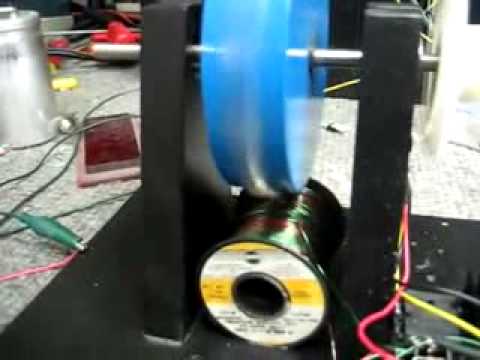
I have tried to get a self triggered SSG to work in the Zero Force motor configuration and it would not trigger on a air core until I inserted iron in the core, then it ran as expected. The major point is... it would not generate enough to trigger a trigger pulse without the iron core. Maximizing your machines generation capabilities is the ticket, erfinder put me on to this point and I spent many hours studying these things and one device that blew it wide open for me was the pendulum, the explanation in the Kromrey papers and those old radio Bill Jenkins shows, in it John Bedini discusses and or describes the pendulum operation with generation capabilities as well. Look for what Kromrey said about attraction and generation, to me these are key points. Key points used in the SSG to be specific. Here is the link...http://rexresearch.com/infolios/kromrey.pdf
Here is a SSG drawing that I drew with the waveform also included, going negative. It can dump to the primary or the secondary. It still lost primary voltage when hooked up across the primary because I needed more coil surface area, I have not had time to do so.
Aaron I am not coming at you... Hope you are not thinking that... I am of course still learning just like anyone and I do not have all the answers by any means. Often I can become confused and always welcome the chance to reason out until truth prevails. So are any of these things I brought up in this post to be a move in the right direction?
Dave WingAttached FilesLeave a comment:
-
Leave a comment: